

Appendix A: Protection Curves
Dependent Time Delay Current Protection Types
Section titled “Dependent Time Delay Current Protection Types”The following curves show the relationship between current ratio (I/In) and trip time for different protection curve types when the time constant parameter it = 1 second.
When a different value for time constant is set, the protection trip time changes proportionally to the time constant. For example, at it = 10 seconds, the protection trip time at the same current ratio will increase 10 times.
Protection Curve Types
Section titled “Protection Curve Types”| Type | Description | Standard |
|---|---|---|
| SIT | Standard Inverse Time | IEC 60255-3 / BS 142 |
| VIT (LTI) | Very Inverse Time (Long Time Inverse) | IEC 60255-3 / BS 142 |
| EIT | Extremely Inverse Time | IEC 60255-3 / BS 142 |
| UIT | Ultra Inverse Time | IEC 60255-3 / BS 142 |
| RI | RI Type | IEC 60255-3 / BS 142 |
Protection Curves
Section titled “Protection Curves”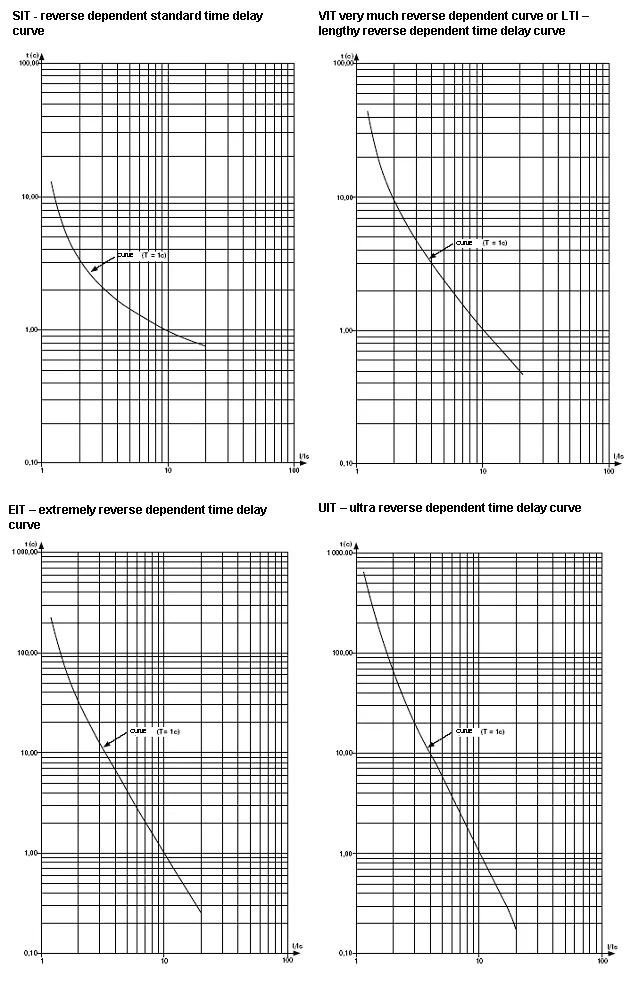
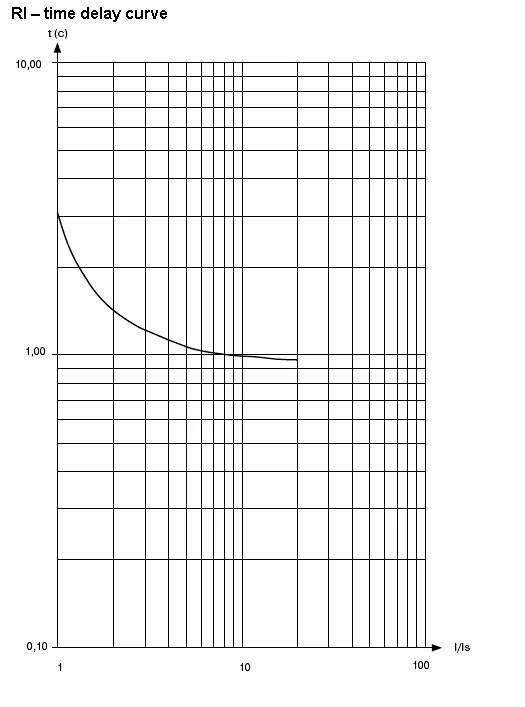
Curve Formulas
Section titled “Curve Formulas”The operation of the dependent time delay protection conforms to IEC 60255-3 and BS 142 standards.
Standard Inverse Time (SIT):
Very Inverse Time (VIT/LTI):
Extremely Inverse Time (EIT):
Ultra Inverse Time (UIT):
Where:
- t = trip time in seconds
- T = time constant (parameter it)
- I = measured current
- In = rated current (parameter In)
Usage Notes
Section titled “Usage Notes”-
Select the appropriate curve type using parameter iP:
- 0 = Independent time delay (constant)
- 1 = SIT (Standard Inverse Time)
- 2 = VIT/LTI (Very Inverse Time)
- 3 = EIT (Extremely Inverse Time)
- 4 = UIT (Ultra Inverse Time)
- 5 = RI Type
-
The time constant it corresponds to the trip delay time for 10×In
-
To deal with very high amperage currents, the protection has a feature with an independent time delay