

OM-310 Operating Manual
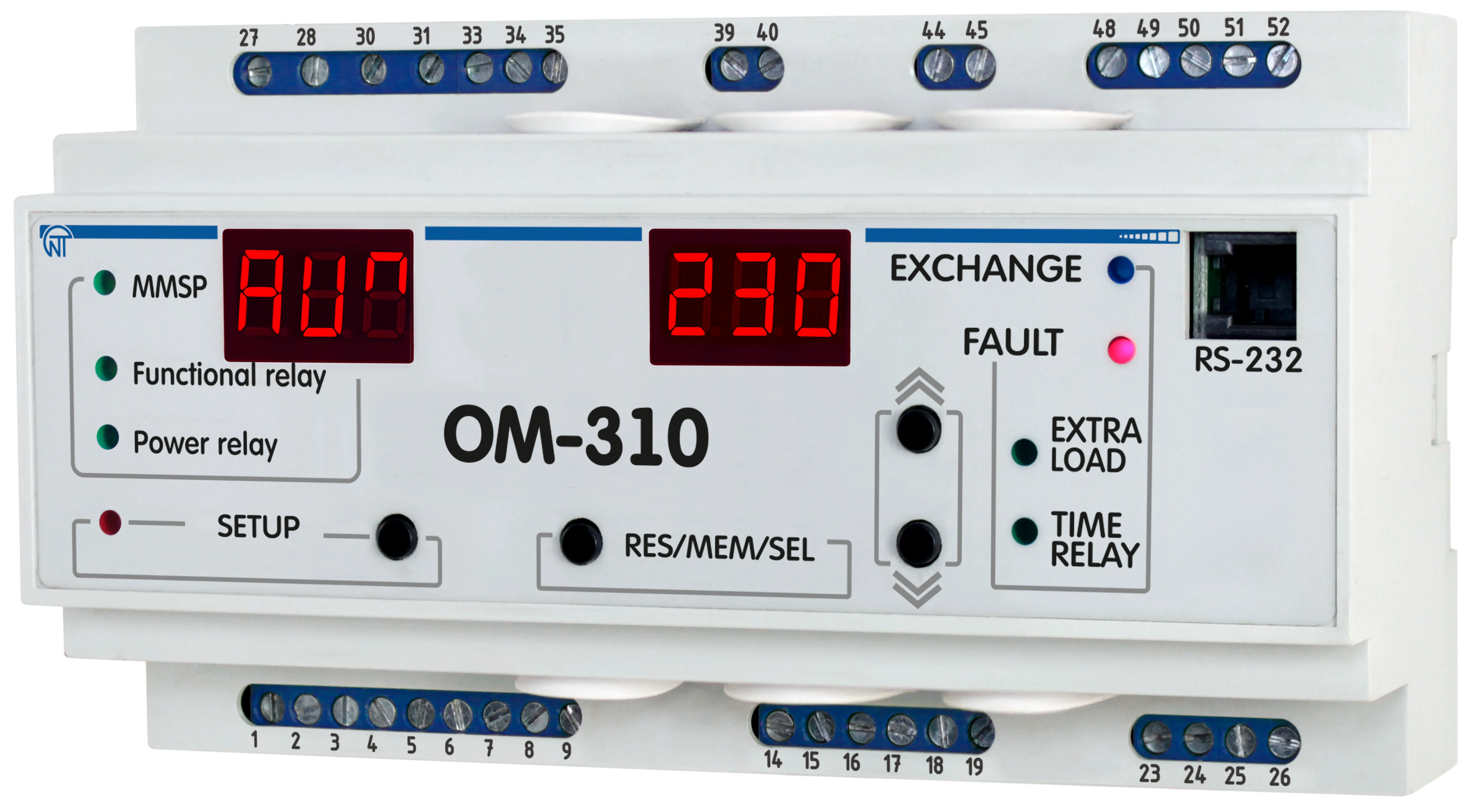
NOVATEK-ELECTRO LTD
Intelligent Industrial Electronics
POWER LIMITER OM-310
OPERATING MANUAL
Quality control system on the development and production complies with requirements ISO 9001:2015
Dear Customer,
NOVATEK-ELECTRO Ltd. Company thanks you for purchasing our products.
You will be able to use properly the device after carefully studying the Operating Manual.
Store the Operating Manual throughout the service life of the device.
Review the Operating manual before using the unit.
Store the unit in the operating environment for 2 hours before switching to the mains.
UKRAINE, Odesa — www.novatek-electro.com
This unit is safe for use in case of compliance with operating rules.
OM-310 complies with requirements:
- EN 60947-1
- EN 60947-6-2
- EN 55011
- EN 61000-4-2
No harmful substances in excess of the maximum permissible concentration is available.
1. Description and Operation
Section titled “1. Description and Operation”1.1 Application
Section titled “1.1 Application”1.1.1 OM-310 power limiter is designed for the following applications:
Section titled “1.1.1 OM-310 power limiter is designed for the following applications:”- Load protection at poor parameters of the mains
- Complete load cutoff in case if watts input exceeds the main threshold within the user-set time period
- Partial load cutoff in case if watts input exceeds the additional threshold within the user-set time period
- Measurement and indication of 3-phase electric circuit (delta voltage and mesh voltage RMS values; positive phase, negative phase and zero phase sequence voltages; phase currents RMS values; input wattage of active power, reactive power, apparent power, power factor (cos φ))
- Fault warning
- Remote load on and off via RS-232/RS-485 interface or an external switch
OM-310 provides for operation under loads ranging from 2.5 kW to 30 kW with use of integrated current transformers, and up to 350 kW at use of external current transformers, including when in networks with insulated neutral.
OM-310 device provides the following types of load protection:
- When the mains voltage is of poor quality (impermissible voltage surges, phase loss, incorrect phase sequence and phase “coincidence”, phase/line voltage imbalance)
- When maximum specified current in any load phase is exceeded
- Against “ground” leakage currents
For each separate type of protection, the unit allows to enable or disable automatic reset (AR).
OM-310 provides electric equipment protection by means of a magnetic starter (contactor) coil control.
Using OM-310 the user has possibility to choose functionality of additional relay and use it for following operations:
- Signalization of emergency situations
- Contactor connection of additional loading
- As time relay
- Signalization of reactive power excess
- Signalization of active power excess
Communication
OM-310 provides for:
- Control and parameters transfer via RS-485 interface according to MODBUS protocol
- Control and parameters transfer via RS-232 interface
Interaction of PC and OM-310 is possible via “OM-310 Control Panel” Software that can be downloaded from the Novatek-Electro website www.novatek-electro.com.
OM-310 Control Panel software is dedicated for monitoring status and retrieving data from OM-310 devices via standard communication interface (RS-232 or RS-485). The Software allows for saving (loading) various OM-310 settings, retrieving data and saving them for further research. The user can view saved data in a graph, while comparing parameters.
The CP graphic environment allows for real-time viewing the current status of various OM-310 parameters.
The flexible interface design allows tuning it to any user’s preferences.
1.1.2 OM-310 application limitations and proper selection of parameters
Section titled “1.1.2 OM-310 application limitations and proper selection of parameters”1.1.2.1 Use of integrated current transformers
When measuring load currents from 63A to 300A, the measurement error does not exceed 5%, while at currents over 320A, the current transformer core saturation starts, and the measurement error increases rapidly. Regardless of the actual current value, the current measured by OM-310 will not exceed 400A. Setting up certain programmable parameters (maximum current protection) without regard to current transformers saturation will make protection tripping impossible.
For example, at ind=50 (load rated current), i=P=0 (ratio of independent delay current protection), i=5=9 (maximum current protection tripping), the maximum current protection would have tripped at current value of 450A. Due to current transformer saturation, the measured current value will not exceed 380-400A, even in case of a short circuit from the load side, and currents of over 1000A, and, therefore, OM-310 will not de-energize the load. In such case (ind=50) the user shall set the overcurrent tripping ratio to not more than 6.
1.1.2.2 Use of external current transformers
The rated current of the external standard current transformers must be no less than the rated load current.
1.1.4 List of abbreviations used
Section titled “1.1.4 List of abbreviations used”- AR – automatic reset
- MC – magnetic contactor
- PC – personal computer
- CT – current transformer
- MMSP – mode with minimal number of setting parameters
- Itt – rated current of CT (Specified when external CTs are used. For example, if a CT of T type-0.66 300/5, then Itt will equal 300A)
- In – rated current of load
1.2 Technical Brief
Section titled “1.2 Technical Brief”1.2.1 Basic technical parameters
Section titled “1.2.1 Basic technical parameters”Table 1.1 – General Information
| Parameter | Value |
|---|---|
| Purpose of device | Control and distribution equipment |
| Assembly (mounting) type | DIN-rail mounting |
| Enclosure protection degree | IP10 |
| Climate zone version | NF 3.1 |
| Pollution degree | III |
| Overvoltage category | III |
| Wire cross section of adapters on terminals, mm² | 0.5–2 |
| Torque of terminal screws, Nm | 0.4 |
| Maximum diameter of wire when using internal current transformers, mm | 12 |
Table 1.2 – Characterizing output terminals of relays
| Relay Type | Max. current at U~ 250V | Number of trips ×1000 | Max switching power, VA | Max sustained safe AC/DC voltage | Max. current at U=30V DC |
|---|---|---|---|---|---|
| Load relay (Cos φ = 0.4) | 2 A | 200 | 500 | 440/125 V | 1.3 A |
| Load relay (Cos φ = 1.0) | 8 A | 100 | 2000 | 440/125 V | 1.3 A |
| Characterizing relay (Cos φ = 0.4) | 5 A | 400 | 1250 | 440/125 V | 3 A |
| Characterizing relay (Cos φ = 1.0) | 16 A | 50 | 4000 | 440/125 V | 3 A |
Table 1.3 – Basic Technical Parameters
| Parameter | Value |
|---|---|
| Rated supply voltage | Three-phase 415V 50Hz |
| Mains frequency, Hz | 48–62 |
| Rated load wattage range (integrated CTs), kW | 3–30 |
| Tripping threshold accuracy for wattage, % of rated | ≤5 |
| Tripping threshold accuracy for current, % of rated | ≤2 |
| Tripping threshold accuracy for voltage, V | ≤3 |
| Phase imbalance detection accuracy for voltage, V | ≤3 |
| Minimum operational voltage (single-phase, one phase + neutral), V | ≥180 |
| Minimum operational voltage (three-phase), V | ≤450 |
| Power consumption (under load), VA | ≤5.0 |
| Weight, kg | ≤0.5 |
| Case dimensions | Nine S-type modules |
| Mounting | Standard 35 mm DIN-rail |
| Mounting position | Any |
Analog inputs:
- Remote switch connection input
- Three analog inputs for connecting standard CT with 5A output (of T-0.66 type or similar)
- Input for connecting differential current transformer (zero sequence transformer)
Main outputs:
- Load relay – two groups of changeover contacts – 8A 250V cos φ=1
- Characterizing relay – one group of changeover contacts – 16A 250V at cos φ=1 (the relay function is assigned by the user)
1.2.2 Measured and calculated parameters
Section titled “1.2.2 Measured and calculated parameters”Measured and calculated parameters output to the display unit.
Measured and displayed parameters, their effective range limits and tolerances are shown in Table 1.4 of Appendix B: Modbus Communication.
1.2.3 Programmable parameters
Section titled “1.2.3 Programmable parameters”Programmable parameters and their variability ranges are shown in Table 1.5 of Appendix B: Modbus Communication.
1.2.4 Operating controls and dimensions
Section titled “1.2.4 Operating controls and dimensions”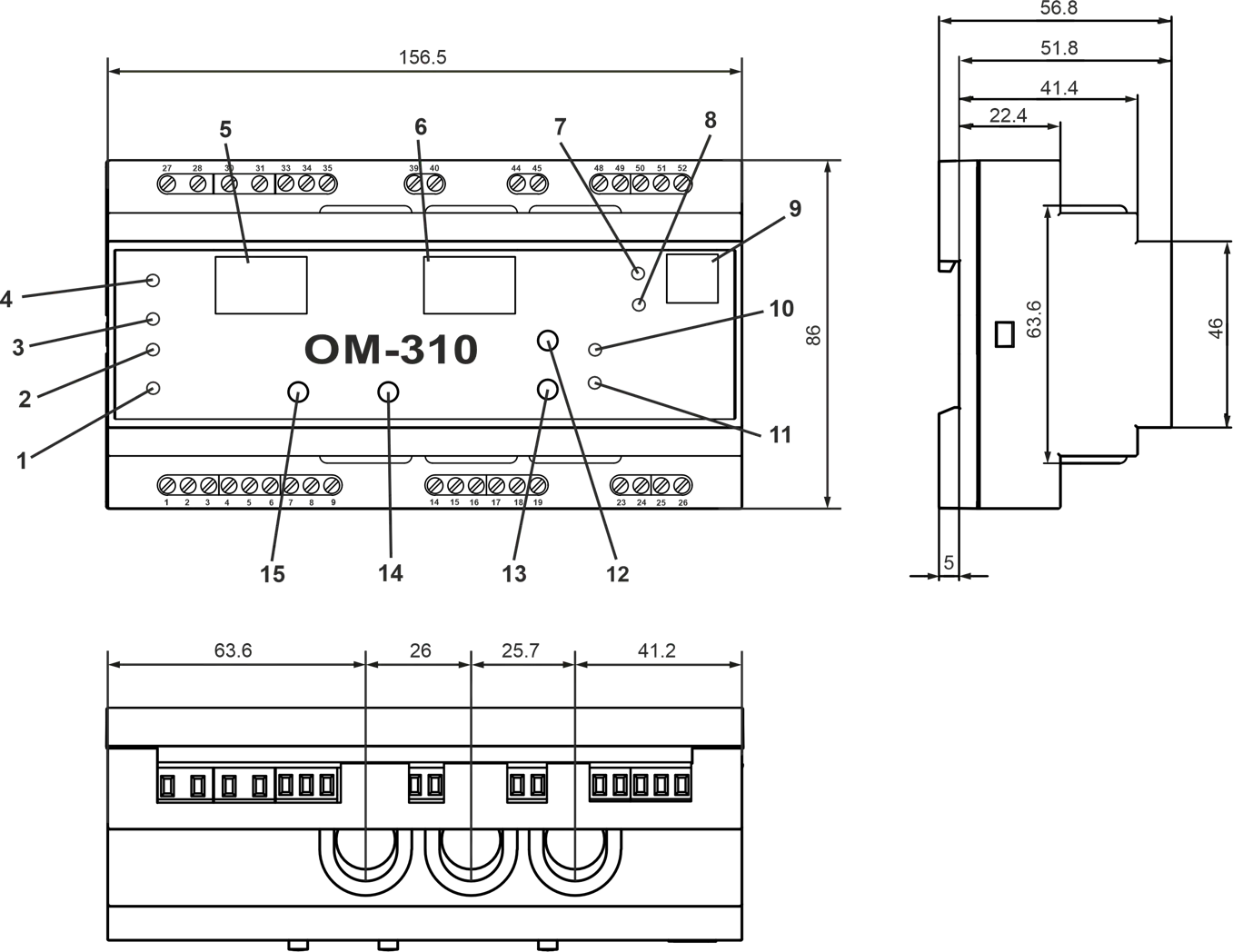
Front Panel Elements:
- Red LED SETUP – glows when the relay is in parameter setup mode
- Green LED LOAD – glows when the load relay is closed
- Green LED RELAY – glows when the characterizing relay is closed
- Green LED MMSP – glows when the relay is in MMSP mode (mode with minimal number of setting parameters)
- Three-digit parameter mnemonic indication display:
- Dot in lower case: OM-310 is in service engineer access mode
- Dot in middle case: setup parameter value is secured by service engineer password
- Dot in upper case: setup parameter is not included in the MMSP list
- Three-digit parameter value indication display
- Blue LED EXCHANGE – glows during data exchange with PC
- Red LED FAULT:
- While load relay is open: glows when OM-310 is in fault mode (flickers when AR after fault is possible)
- While load relay is closed: flickers when consumed input power is over the main threshold, but load relay open time has not yet been reached
- Plug connection for connecting OM-310 to PC via RS-232
- Green LED – glows when characterizing relay works in the mode of controlling additional load
- Green LED TR – glows when characterizing relay functions in time relay mode; blinks when working in signalization mode of main tripping exceeding of active power
- Button ▲ (UP) – scroll through indicated parameters in view mode; scroll through menus in setup mode
- Button ▼ (DOWN) – scroll through indicated parameters in view mode; scroll through menus in setup mode
- Button RES/MEM/SEL – record parameters in setup mode; switch between groups of parameters in view mode; reset
- Button SETUP – engages the parameter setup mode
Figure 1.1 – OM-310 device controls and dimensions
1.2.5 Power Limiting Functions
Section titled “1.2.5 Power Limiting Functions”1.2.5.1 Assumptions utilized in power limiter function description:
a) Voltage and current protections are off or corresponding parameters values are within permissible limits
b) When energized, the load relay will close after AR time (APd=1 parameter)
c) Time specified by t1n parameter exceeds the AR time (Att parameter)
1.2.5.2 Limitation of active power if parameter rr5 ≠ 2
Under all relay activity conditions except using it for connection of additional loading:
After OM-310 energizing, after AR time (Att parameter) the load relay will close. If during operation the active power consumed by the load crosses the main threshold for a time that is longer than assigned by t1n parameter, the load relay will open. The load will be energized again after AR period, or after time specified by t1F parameter (whichever is longer).
The main threshold value and the power overload calculation depend on the rPn parameter value:
When rPn=0: The load consumed wattage is calculated for each phase separately and is compared with the main threshold calculated as:
Main threshold (kW) = (
Pnn×P1F) / (100 × 3)
Where:
Pnn– cumulative rated load wattage, kWP1F– main threshold, %
When rPn=1: The cumulative load power input for all three phases is compared with the main threshold calculated as:
Main threshold (kW) = (
Pnn×P1F) / 100
Simultaneously, the load input power is calculated for each phase separately and is compared with the second threshold (threshold calculation for each phase + 20%):
Second threshold (kW) = (
Pnn×P1F× 1.2) / (100 × 3)
Watt consumption crossing the first and the second thresholds is considered crossing the main threshold.
When rPn=2: The cumulative load power input is compared with the main threshold calculated as:
Main threshold (kW) = (
Pnn×P1F) / 100
Figure 1.2 – OM-310 operation in the power limiting mode when rr5=0, rr5=1, rr5=3
Where:
Att– AR timet1n– time after which the load relay will open if the watts input crosses the main thresholdt1F– time during which the load relay will be open after de-energizing resulting from the watts input crossing the main threshold
1.2.5.3 Active power limiting during operation of characterizing relay at rr5=2
When relay is used for connecting additional load:
After OM-310 energizing, after AR time (Att parameter) the load relay will close. After the delay, defined by t12 or Att parameter (whichever time is longer), the characterizing relay closes while connecting additional load.
If during operation the active power consumed by the load crosses the additional threshold for a time period that is longer than assigned by t2n parameter, the characterizing relay will open.
Characterizing relay will re-close again:
a) At r2r=0, after time assigned by t2F parameter
b) At r2r=1, when load consumed power will reduce till the additional load power-on threshold (P2n)
c) At r2r=2 depending on which event (a or b) comes first
If during operation the active power consumed by the load crosses the main threshold for a time period that is longer than assigned by t1n parameter, the characterizing relay and the load relay will open.
The load relay and characterizing relay will be re-closed after AR period, or after time specified by t1F parameter (whichever of the time periods is longer).
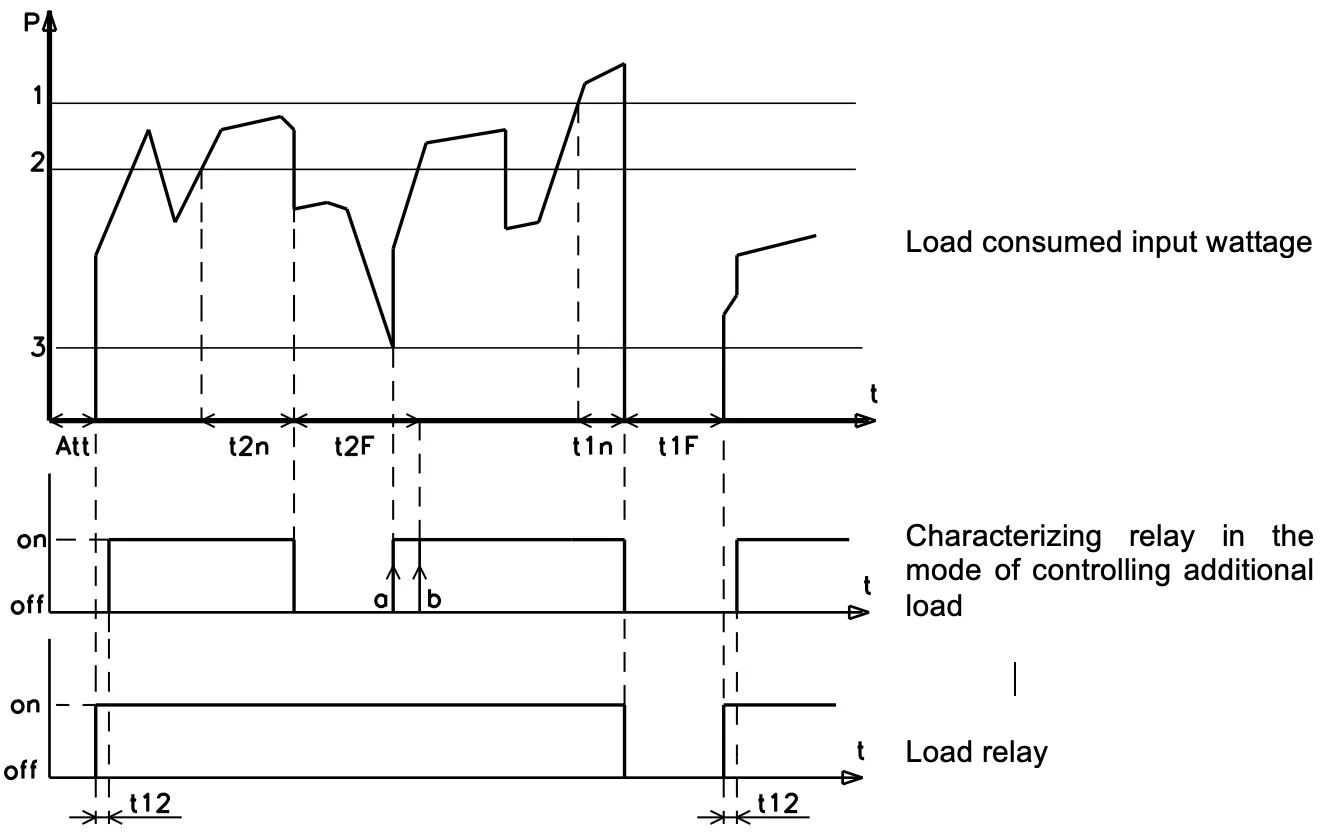
Figure 1.3 – OM-310 operation in the power limiting mode when rr5=2
Where:
- 1 – main threshold (
P1Fparameter) - 2 – additional de-energize threshold (
P2Fparameter) - 3 – additional energize threshold (
P2nparameter)
The wattages values for the main threshold, the additional threshold, and the additional load energize threshold depend on the rPn parameter value.
When rPn=0: The load consumed power is calculated for each phase separately and is compared with the thresholds calculated as:
Main threshold (kW) = (
Pnn×P1F) / (100 × 3)Additional threshold (kW) = (
Pnn×P2F) / (100 × 3)
When rPn=1: The main threshold, the additional threshold and the energizing threshold are calculated similarly to paragraph 1.2.5.2.
When rPn=2: The thresholds values (kW) are defined as follows:
Main threshold (kW) =
Pnn×P1F/ 100Additional threshold (kW) =
Pnn×P2F/ 100
At any value of rPn, the additional load energizing threshold shall be determined as:
Energizing threshold (kW) = (
Pnn×P2n) / 100
Where P2n – additional load energizing threshold, %
1.2.6 Protection functions
Section titled “1.2.6 Protection functions”1.2.6.1 Protection types
OM-310 device provides the following types of load protection:
- Maximum phase current
- Against line-to-earth fault (based on zero sequence current)
- For minimum line voltage
- For maximum line voltage
- For line voltages imbalance (voltage negative sequence)
- For phase sequence order
- Starter unit operability control
1.2.6.2 The overcurrent protection parameters are assigned relatively to the rated load current In (ind parameter).
1.2.6.3 Overcurrent protection
The overcurrent protection is of three-phase type. It is engaged when at least one of the phase current values reach the tripping threshold.
The protection has a time delay setting. The delay can be independent (constant), or dependent:
- SIT – standard inverse (reverse dependent)
- VIT or LTI – very inverse (very reverse dependent)
- EIT – extremely inverse (extremely reverse dependent)
- UIT – ultra inverse (ultra reverse dependent)
- RI – type delay
The tripping curves are displayed in Appendix A: Protection Curves.
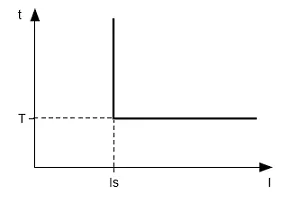
When independent time delay protection is activated, the load relay is de-energized if one of the phases current exceeds the threshold value within T period of time (parameter i=t).
Is =
i=5(tripping ratio) × In (load rated current)T – protection tripping delay time
Example: When i=5=4.0, In=10, i=t=10.0, the load relay shall open in 10 sec after one of the phase currents crosses 40 A value.
Figure 1.4 – Principle of protection with an independent time delay
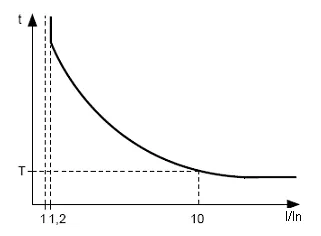
The operation of the dependent time delay protection conforms to IEC 60255-3 and BS 142 standards.
- In corresponds to the
indsetting (rated current of load) - T (parameter
i=t– protection function time constant) corresponds to the trip delay time for 10×In
To deal with very high amperage currents the protection has a feature with an independent time delay.
Figure 1.5 – Principle of protection with dependent time delay
Graphs for the protection operation time constant equal to 1 sec (i=t parameter) are provided in Appendix A.
When a different value for time constant is set, the protection trip time changes proportionally to the time constant (for example, at i=t=10 seconds the protection trip time at the same current ratio will increase 10 times).
1.2.6.4 Ground fault protection
- Is activated when earth fault current reaches the trip threshold (
i_5parameter) - The load relay opens if the earth fault current crosses the trip threshold within T time period (
i_tparameter)
1.2.6.5 Voltage based protection
In voltage-based protections, before load energizing, OM-310 checks for corresponding threshold settings, and, depending on their value, either permits or prohibits load energization; after load energization the voltage control is retained.
Voltage-based protections include:
- Protection for minimum line voltage – trips when at least one of the line voltages is less than the threshold setting (
U_5parameter) within time specified byU_tparameter - Protection for maximum line voltage – trips when at least one of the line voltages is greater than the threshold setting (
U¯5parameter) within time specified byU¯tparameter - Protection for line voltages imbalance – trips if difference between RMS line voltages exceeds the set threshold (
Un5parameter) within time assigned byUntparameter
1.2.6.6 Phase sequence protection trips in case of phase sequence order fault or phase coincidence – it opens the load relay and locks its further operation.
1.2.6.7 Starter unit operability control (at CCi=1). If currents are present when the relay is open, the starter is considered faulty. Further OM-310 operation is locked. The alarm reset can be performed by de-energizing only.
1.3 Operating conditions
Section titled “1.3 Operating conditions”The product is designed for operation in the following conditions:
- Ambient temperature: from −35 to +55°C
- Atmospheric pressure: from 84 to 106.7 kPa
- Relative air humidity (at temperature of +25°C): 30–80%
1.4 Product package contents
Section titled “1.4 Product package contents”Table 1.7 – Product package contents
| Description | Abbreviation |
|---|---|
| OM-310 | OM-310 |
| Differential current transformer (zero sequence transformer)* | — |
| Cable for communication with PC via RS-232* | KC-01 |
* Supplied optionally
1.5 Equipment features and operation
Section titled “1.5 Equipment features and operation”OM-310 is a microprocessor-based digital device that provides a high degree of reliability and accuracy. The device doesn’t need any auxiliary supply: it’s self-powered by the voltage to be monitored.
OM-310 device is equipped with three built-in CTs, through which power phase mains are conducted.
2. Intended Use
Section titled “2. Intended Use”2.1 Safety
Section titled “2.1 Safety”2.2 OM-310 device control
Section titled “2.2 OM-310 device control”2.2.1 Control Modes
Section titled “2.2.1 Control Modes”OM-310 has five control modes:
- Keyboard lock level
- Mode with minimal number of setting parameters (MMSP)
- User level
- Service engineer level
- Remote control
In all operation modes the following features are available:
- Viewing measured and displayed parameters (Table 1.4). Scrolling through parameters list is performed by DOWN and UP buttons
- Faults log view (see section 2.4.8)
2.2.2 Disabled keypad mode
Section titled “2.2.2 Disabled keypad mode”When keypad is locked, viewing and resetting programmable parameters is not possible.
When keypad is locked, pushing SETUP button will result in LOC message display. To unlock the keyboard:
- Press the SETUP button again
- The “SETUP” LED lights up, and figure “0” is blinking on the indicator
- With the UP and DOWN buttons enter a password digit from 1 to 9
- Press the RES/MEM/SEL button
If the password is correct, the keypad will be unlocked. If after the keypad was unlocked no button is pressed during 15 sec and the lockage setting is not released by user, the keypad will relock.
The unblocked keypad allows:
- To operate in MMSP mode
- To change and to view the user level parameters
- To view the service engineer level parameters
2.2.3 MMSP – mode with minimum number of setting parameters
Section titled “2.2.3 MMSP – mode with minimum number of setting parameters”MMSP is devised to ease the service personnel’s operations with OM-310.
To employ MMSP mode in OM-310, the user needs to set 5in=1 parameter, or perform resetting to factory settings. When OM-310 is in this operation mode, green LED “MMSP” is on.
In MMSP for normal activity of OM-310 it is enough to fix parameter Pnn (nominal active power). If necessary, also parameters t1n (time before loading relay will be switched OFF after energy input exceeding main threshold) and t1F (time interval of cut off loading relay on energy input exceeding main threshold).
On duty of external CT it is necessary to fix following parameters:
- Type of CT (parameter
tPt) – external - Nominal current of CT (parameter
tnt)
The difference between MMSP mode and the user mode is that the parameters not included in the MMSP register are set to default factory values.
The parameters included in this register cannot be viewed or modified. Operations with the MMSP register parameters are similar to the user level operations.
Adding parameters to the MMSP register and MMSP mode disabling is possible only in service engineer access mode.
When switching off the MMSP mode (setting parameter 5in=0) LED “MMSP” goes off. In the user mode all parameters list is displayed.
2.2.4 User level
Section titled “2.2.4 User level”To view and to change the user level parameters:
- Press the SETUP button – “SETUP” LED will glow
- Scroll parameters with DOWN and UP buttons
- Enter parameter change mode – press SETUP button again (the parameter value starts to flicker)
- Change parameters with DOWN and UP buttons
- Record parameter – press RES/MEM/SEL
- To return to menu without change – press SETUP button again
If no button is pressed during 30 sec the OM-310 will transfer to the initial state.
If a parameter change is forbidden (a dot in the middle digit field of the parameter mnemonic indicator glows), then the parameter change is possible only in Service Engineer level after the prohibition has been released.
2.2.5 Service Engineer Level
Section titled “2.2.5 Service Engineer Level”Access to the Service Engineer level:
- Push SETUP button and hold for 5 sec
- If the level is protected by a password, the label
PASappears on the indicator - The “SETUP” LED lights up, and indication “000” flickers on the parameter value indicator
- With the UP and DOWN buttons enter the three-digit service engineer password, digits from 1 to 9, and separate dialing with pressing the RES/MEM/SEL button
If the password is incorrect, the PAS label lights on blinking in the higher position of the value indicator, and OM-310 goes back to the initial state after 15 sec. Otherwise the first parameter of the service engineer menu appears on the indicator.
Scroll parameters with DOWN and UP buttons, enter parameter change mode – press SETUP button (the parameter value starts to flicker), change parameters – with DOWN and UP buttons, record parameter – RES/MEM/SEL, to return to menu without change – press SETUP button again. If no button is pressed during 30 sec the OM-310 will transfer to the initial state.
While OM-310 is in Service Engineer mode, the decimal point in the lower digit position of the mnemonic indicator is on.
In the Service Engineer level the access to any user level parameter can be prohibited or permitted by simultaneous pressing the SET and DOWN buttons. Access denial is indicated by decimal point in the middle digit position of the mnemonic indicator.
Adding parameters to MMSP register (while in Service Engineer access mode):
- With DOWN and UP buttons choose the parameter to be added
- Push buttons DOWN and UP simultaneously
Excluding a parameter from the MMSP register:
- With DOWN and UP buttons choose the parameter to be excluded
- Push buttons DOWN and UP simultaneously
When a parameter is excluded from the MMSP mode register, a decimal point glows in the higher digit position of the mnemonic indicator.
2.2.6 Restoring factory settings
Section titled “2.2.6 Restoring factory settings”There are two ways to restore the factory settings.
Way 1: Set up parameter PPP=1. Upon exit from the parameter setup mode all factory settings will be restored (except the Service Engineer Password).
Way 2: When powering OM-310 on, hold down SETUP and RES/MEM/SEL buttons for 2 seconds. All factory settings including the Service Engineer password will be restored (Service Engineer password – 123).
After completion of the factory settings setup, OM-310 will start operation in MMSP mode, which includes the following parameters:
- CT type (external or integral):
tPt - CT rated current (set in case of external CT):
tnt - Rated power of load:
Pnn
2.3 OM-310 pre-operation procedure
Section titled “2.3 OM-310 pre-operation procedure”To improve the performance, it is recommended to install fuses (fuse links or their analogs) in the following circuits:
- OM-310 power supply circuits (27, 28, 30, 31 - L1, L2, L3, N) – 1 A
- Remote control circuits (51, 52), RS-485 (33, 34, 35) – 0.5 A
2.3.1 When operating with load power ranging from 3 kW to 30 kW, use of built-in current transformers is allowed. The mains leading to the load must be conducted through openings in OM-310 casing (each phase wire uses a separate opening).
When using other capacity loads, current transformers with 5A rated output current shall be connected. For correct OM-310 operation, the current transformers’ polarity must be observed.
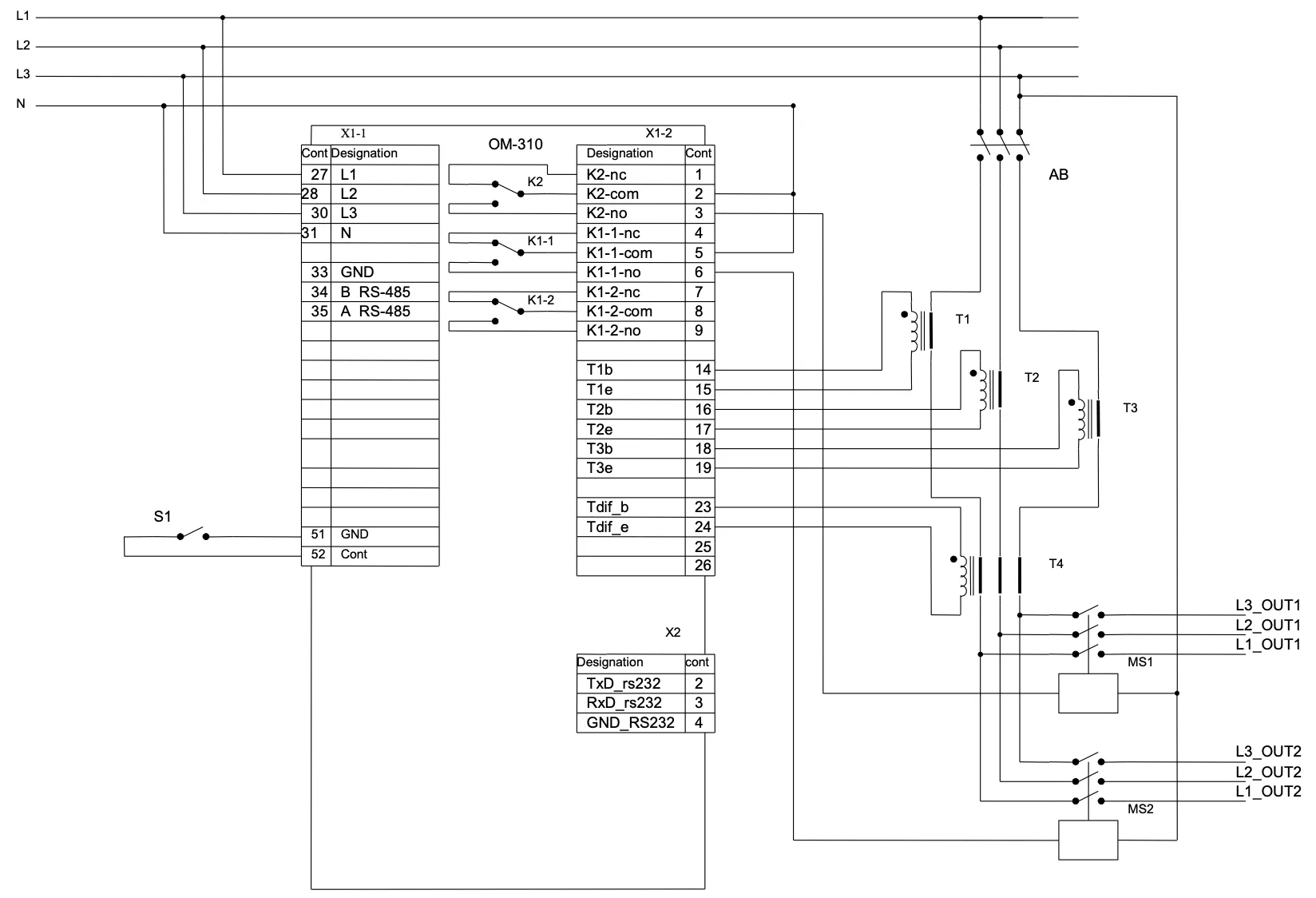
Figure 2.1 – OM-310 connection schematic with use of external CTs and at rr5=2 (characterizing relay operation in the mode of controlling additional load)
Where:
- S1 – remote switch
- AS – automatic switch
- MC1 – additional load magnetic contactor
- MC2 – main load magnetic contactor
- K1 relay – load relay
- K2 relay – characterizing relay
- T1-T3 – external CTs
- T4 – differential current transformer
2.3.2 Run all three power phase cables through differential current transformer (zero sequence transformer) and connect the DCT to OM-310.
2.3.3 Connect OM-310 to power mains in accordance with Figure 2.1.
2.3.4 To operate OM-310 via PC as control or monitoring device with use of “OM-310 Control Panel” software:
- Install “OM-310 Control Panel” software to your PC by running software “Setup_cpl_pl310(XX).exe”, where XX – program version number
- Connect PC connection plug on OM-310 front panel to RS-232 plug on PC with use of KC-01 cable
- Set parameter
rPP=1
2.3.5 When using MODBUS, connect communication lines to terminals 33, 34, 35 of OM-310. Set rPP=2 parameter.
2.3.6 Energize OM-310.
Load relay closing sequence is controlled by APd and ACd parameter values.
2.3.7 Set up required parameter values in the menu.
2.3.8 De-energize OM-310.
2.3.9 Connect the load magnetic contactor (MC) according to Figure 2.1.
2.4 Intended Use
Section titled “2.4 Intended Use”2.4.1 OM-310 operation before load relay closure
Section titled “2.4.1 OM-310 operation before load relay closure”2.4.1.1 OM-310 operation after power-on (first start)
After power-on, the mnemonic indicator displays 5tA for 1-2 seconds, and then before load energizing OM-310 tests:
- Mains voltage quality: whether voltage is present on all three phases, if the mains voltage is symmetrical, what the RMS line voltage value is
- Correct phase sequence, absence of phase fritting
When any of inhibiting factors is present, the load relay is not closed, and on the mnemonics indicator FAULT LED glows.
Depending on the 5iP parameter, the indicator displays:
- Line voltage
UAbat5iP=0 - Active power (
PoA) at5iP=1 - AR time countdown in seconds (
Att) at5iP=2
When power-on inhibiting factors are not present, the load relay closure is defined by APd parameter value (OM-310 device operation after power-on):
- At
APd=0 the load relay will not close. To close load relay in this case, both DOWN and UP buttons have to be pressed simultaneously - When
APd=1 the load relay will close after AR time - When
APd=2 the load relay will close in 2 sec after power-on
Simultaneously with the load relay closure, green LED LOAD starts to glow.
OM-310 operation with remote control permitted via RS-232/RS-485 (dUd=1, dUd=2) is covered in section 2.4.5.
OM-310 operation with remote control permitted via switch (dUc=1, dUc=2) is covered in section 2.4.6.
2.4.1.2 OM-310 operation after a fault-caused de-energizing
The OM-310 device operation in such case is similar to the first start operation, but the load relay closure is not dependent on the APd parameter value.
If after a fault AR is prohibited (Arr=0), the load power-on is not possible before OM-310 de-energizing. Arr parameter value is effective for all types of faults except voltage faults. i=r, U_r, U¯r, Unr parameters shall be used to prohibit AR in case of voltage faults.
2.4.1.3 OM-310 operation after de-energizing tripping caused by exceeding the watt input
OM-310 operation in this case is covered under section 1.2.5.
2.4.2 OM-310 operation after load relay closure
Section titled “2.4.2 OM-310 operation after load relay closure”After load relay closure OM-310 performs the following:
- Control and limiting the active and reactive power by input load wattage (section 1.2.5)
- Current overload protection (section 1.2.6.3)
- Protection against line-to-earth fault (section 1.2.6.4)
- Voltage protection (maximum, minimum, phase imbalance) (section 1.2.6.5)
- Starter unit operability control (section 1.2.6.7)
The indicator can display either phase A current or a user-selected parameter value. The value of the user-selected parameter can be displayed either constantly (5iC=0), or within 15 sec, and then phase A current (5iC=1) indication is displayed again.
2.4.3 Characterizing relay operation
Section titled “2.4.3 Characterizing relay operation”Functions performed by the characterizing relay are defined by rr5 parameter.
When rr5=0: The relay functions as signaling alarm relay (EXTRA LOAD and TIME RELAY LEDs are off). The relay contacts are closed in case of any fault specified in Table 2.8.
When rr5=1: The relay functions as time relay (TR LED glows). The relay closes upon expiration of time set by t12 parameter, after load relay closing.
When rr5=2: The relay is used to control switching additional load (EXTRA LOAD LED glows) (see section 1.2.5.3).
When rr5=3: The relay is used for reactive power excess signalization (LEDs EXTRA LOAD and TIME RELAY are on). Functional relay is switched ON by exceeding total reactive power across three phases – Prn (admissible reactive power of loading) and switched OFF if not exceeded.
When rr5=4: The relay is used for active power main threshold excess signalization (LED is blinking). The threshold value is being calculated according to section 1.2.5.2.
2.4.4 Work with RS-232/RS-485 interface under MODBUS protocol in RTU mode
Section titled “2.4.4 Work with RS-232/RS-485 interface under MODBUS protocol in RTU mode”The OM-310 allows for data exchange with an external device via serial interface under MODBUS protocol. During data exchange via RS-485 or RS-232 blue LED “EXCHANGE” glows.
2.4.4.1 Communication parameters:
- Device address: 1–247 (
r5Aparameter) - Data transfer rate: 9600 baud, 19200 baud (
r55parameter) - Response to loss of carrier: warning and continue operation, warning and load de-energizing, continue operation without warning (
r5Pparameter) - Response timeout detection: 1 sec – 120 sec (
r50parameter) - Transmission word format: 8 bit, no parity check, two stop bits
2.4.4.2 OM-310 control from PC
Communication between PC and OM-310 is effected through serial interface. Each OM-310 has a unique communication address. PC controls each OM recognizing them by their address.
OM-310 can operate within RTU mode controlled Modbus networks.
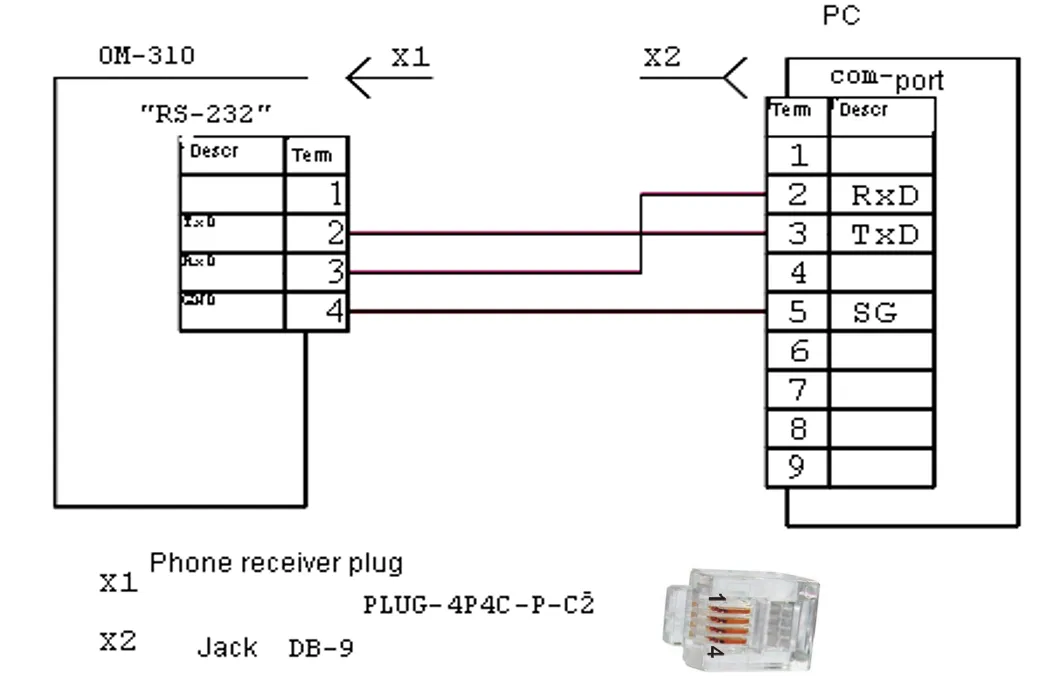
Figure 2.2 – OM-310 connection to PC schematic
2.4.4.3 Communication protocol
The exchange between PC and OM-310 uses Modbus protocol. The data formats and parameters addresses are given in Appendix B: Modbus Communication.
2.4.4.8 Energy meters reset
Section titled “2.4.4.8 Energy meters reset”Reset of energy meters (total, at all phases) is performed when setting the parameter “1” to register 239, when using RS-232/RS-485 interface. After reset of energy meters, OM-310 will automatically switch register 239 to parameter “0”.
2.4.5 Load energize/de-energize remote control via RS-232/RS-485 interface
Section titled “2.4.5 Load energize/de-energize remote control via RS-232/RS-485 interface”OM-310 operation in the remote control mode is defined by the dUd parameter.
When dUd=0: The load energize/de-energize remote control is prohibited.
When dUd=1: The OM-310 device after power-on works similarly as when the remote control is off (normal operation), but writing to the R_COMMAND command register is permitted.
When dUd=2: OM-310 will energize load only after the corresponding command via RS-232/RS-485 has been received.
The R_COMMAND register address and allowed values are given in Appendix B: Modbus Communication.
2.4.6 Load energize/de-energize via remote breaker
Section titled “2.4.6 Load energize/de-energize via remote breaker”OM-310 operation in the remote control mode is defined by the dUc parameter.
When dUc=0: Load energize/cutoff by means of remote breaker is prohibited.
When dUc=1: OM-310 with the open terminal of the S1 remote breaker functions same as during normal operation mode. When the remote breaker terminal is closed, the load relay opens (when rr5=2, the characterizing relay will also open).
When dUc=2: OM-310 with the closed terminal of the S1 remote breaker functions same as during normal device operation. When the remote breaker terminal is open, the load relay opens (when rr5=2, the characterizing relay will also open).
When dUc=3 and dUc=4: OM-310 functions same as dUc=1 and dUc=2 accordingly, but AR after the remote motor de-energizing is forbidden.
2.4.7 Fault conditions system
Section titled “2.4.7 Fault conditions system”In case of fault condition occurrence, the OM-310 performs following actions:
- Mnemonic indicator displays error code according to Table 2.8
- Value indicator displays value of the faulty parameter (if given fault does not have numeric value, the indicator displays ”----”)
- Red LED FAULT lights (glows continuously if AR will not initiate, and flickers if AR is expected)
- Load relay opens
- Characterizing relay closes (when
rr5=0)
If OM-310 defines several types of faults simultaneously, the error codes and parameter values are displayed consecutively, one after one.
If AR is permitted, the fault codes and time left till AR are displayed.
Fault codes mnemonics, register flags and values are shown in Table 2.8 of Appendix B: Modbus Communication.
2.4.8 Fault conditions log
Section titled “2.4.8 Fault conditions log”When load relay in case of fault opens, the OM-310 device stores the fault code, the parameter value, and time of occurrence.
Number of synchronously stored fault codes is five. When next following faults occur, the information of this fault is recorded over the latest fault.
To view log press RES/MEM/SEL button.
The SETUP LED will start to flicker, and the OM-310 indicator panels will display line 1 from Table 2.9. Log scrolling performed by pressing UP and DOWN buttons.
To exit log view mode press RES/MEM/SEL button, or the log will close automatically after 30 sec since last button was pressed.
Table 2.9 – Fault log display
| Mnemonic indicator | Value indicator |
|---|---|
| LOG | Number of log record (1 = latest record) |
| XXX – fault mnemonic | YYY – parameter value (if negative, ”----” is displayed) |
| XXX – hours since fault | YY – minutes since fault occurrence |
Fault log registers are shown in Appendix B: Modbus Communication.
2.4.9 Load start/cutoff control with use of OM-310 front panel
Section titled “2.4.9 Load start/cutoff control with use of OM-310 front panel”Depending on the ACd parameter value, the OM-310 load relay can be controlled by pressing buttons UP and DOWN simultaneously (unless OM-310 is in keypad lock-up mode):
ACd=0 – no responseACd=1 (load energizing permitted) – load relay will close, if AR time has not expiredACd=2 (emergency load de-energize) – load relay will open and produceEAdfault code. Load restart is possible after disconnecting and re-connecting power to OM-310ACd=3 (load energizing and de-energizing permitted) – load relay will open and produceEOdfault code. To close, press UP and DOWN buttons again
3. Maintenance
Section titled “3. Maintenance”3.1 Safety
Section titled “3.1 Safety”3.2 Maintenance schedule
Section titled “3.2 Maintenance schedule”Recommended maintenance schedule – semiannually.
Maintenance scheduled operations consist of visual observation, during which wiring connection to OM-310 terminals is checked, casing integrity check for cracking and chipping.
4. Transportation and Storage
Section titled “4. Transportation and Storage”OM-310 in manufacturer package should be stored in enclosed rooms at −45° to +60°C and exposed to no more than 80% of relative humidity when there are no fumes in the air that have a damaging effect on package and the equipment material.
The customer shall provide for the OM-310 equipment protection against mechanical damage while in transport.
5. Period of Service, Storage, and Manufacturer’s Warranty
Section titled “5. Period of Service, Storage, and Manufacturer’s Warranty”The unit service life is 10 years. Upon expiration of the service life you should contact the Manufacturer.
Shelf life is 3 years.
Warranty period of the unit operation is 5 years from the date of sale.
During the warranty period the Manufacturer is responsible for free repair of the unit, if the Consumer has complied with the requirements of this Operating Manual.
Warranty service is performed at the place of purchase or by the Manufacturer of the product.
Post-warranty service is performed by the Manufacturer at current rates.
Before sending for repair, the unit should be packed in the original or other packaging excluding mechanical damage.
Contact Information:
NOVATEK-ELECTRO Ltd.
59, Mykhailo Boltenko (Admiral Lazarev) str.,
Odesa, Ukraine, 65007
Tel: +38 (067) 565 37 68
Tel: +38 (050) 359 39 11
Tel: +38 (063) 301 30 40